

Writing code is the quick part now
Tools can write a lot of the code. Deciding what to build and how it fits together is still up to you.
Deciding what to build, how to structure it and why the bug is happening all take ideas. Creaocity is short daily practice at having more of them.
Tools can write a lot of the code. Deciding what to build and how it fits together is still up to you.
Every problem starts looking like the stack you know best, and the fit gets worse the longer you don't notice.
Hard bugs get solved by generating hypotheses nobody else considered — fluency under constraint, which is exactly what these exercises train.
The most expensive engineering mistakes are beautifully built things nobody needed. Reframing catches that early.
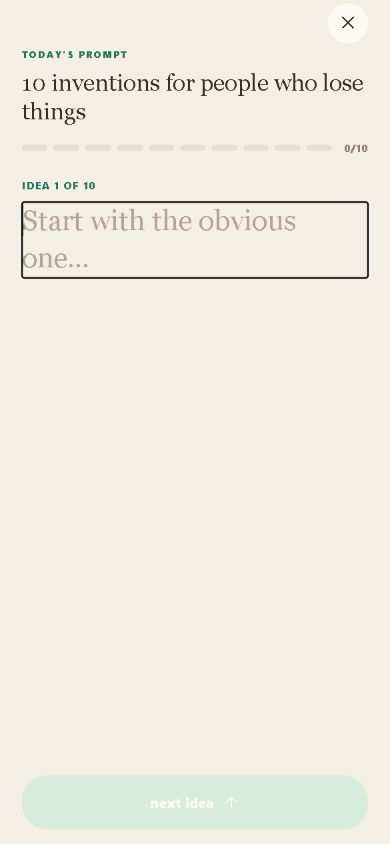
From the app's Dailies. The first few answers are the obvious ones. The last few are usually the good ones.
Ten names for a variable that's lying.
0/10founding prices
Creaocity is coming to iPhone. Leave your email and we'll tell you the day it's out.
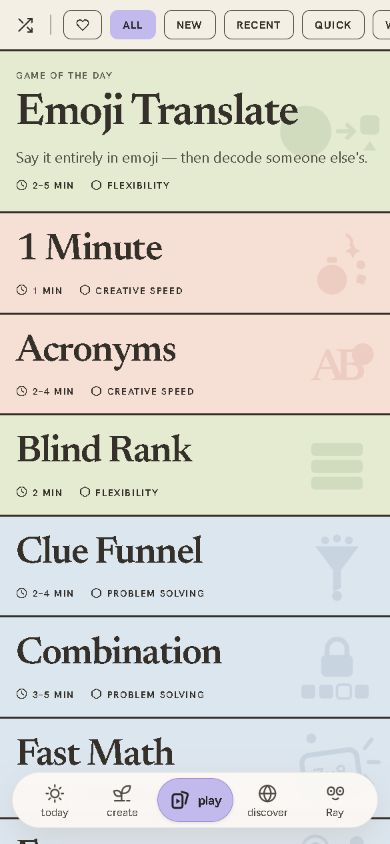
Partly. Some games are puzzles with one answer. Others, like Doodler and 1 Minute, ask for as many different answers as you can find, which is the kind of thinking design and debugging need.
No. It does not teach syntax, frameworks, or interview algorithms. It trains problem framing, hypothesis generation, flexible thinking, and judgement — the parts of software work that sit above implementation.
Yes. Let the coding tool accelerate implementation while Creaocity helps you question the premise, explore architectures, and evaluate the output. Faster code makes those higher-level decisions more important, not less.
Before committing to an architecture, when a bug has exhausted the obvious hypotheses, or when a product request needs reframing. A short exercise is most valuable before the solution space has narrowed.
Yes. Tech leads and engineering managers also need to surface alternatives, explain trade-offs, shape systems, and help teams solve ambiguous problems without jumping to the first plausible answer.
Ideas for meals, play, stories and weekends.
forGet started on the blank page and unstick the middle.
forMore ideas, further from the obvious.
forFresh angles for essays and better questions.
forFresh thinking for strategy and positioning.
forGet out of your usual patterns and finish more songs.