
Your essay says what everyone's essay says
You found the sources and made the safe argument. The marks that go higher come from the angle nobody else took.
Anyone can look up an answer. What gets the good mark is a better question, an argument nobody else made, or a link between two subjects. You can practise that.
You found the sources and made the safe argument. The marks that go higher come from the angle nobody else took.
You can find an answer to almost anything. Knowing which question is worth asking is the harder part.
The most interesting ideas connect two fields. Nothing in a timetable teaches you to do that on purpose.
Starting is the hardest part, and the pressure of a deadline is the worst possible time to be generating from cold.
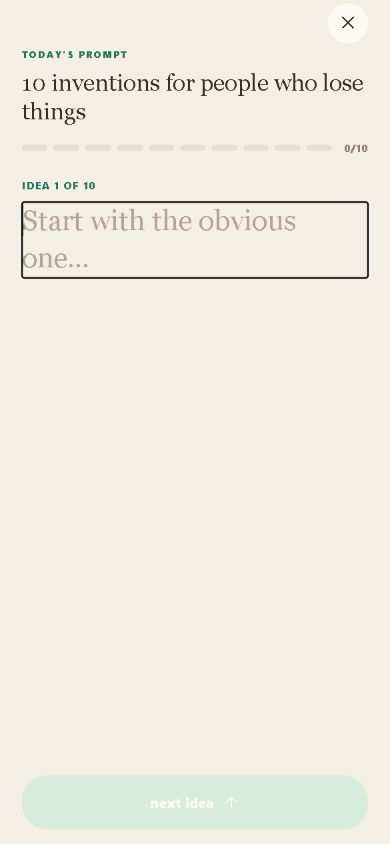
From the app's Dailies. The first few answers are the obvious ones. The last few are usually the good ones.
Ten essay titles about where you grew up.
0/10founding prices
Creaocity is coming to iPhone. Leave your email and we'll tell you the day it's out.
Neither. Creaocity never writes anything for you — it trains your own thinking. Everything you hand in stays entirely your own work.
One subscription unlocks everything: $59.99 a year with a 7-day free trial, or $9.99 a month. There's no separate student price yet.
Essays, presentations, research questions, dissertations, group projects, and open-ended assignments. It is most useful wherever the quality of the question or angle matters as much as recalling the material.
No. It helps you generate questions, connections, and possible directions, but it does not produce an answer to submit. You still research, reason, write, and make the final judgement yourself.
No. A regular rhythm helps, but this is practice rather than a streak to protect. Use it between classes, before starting an assignment, or whenever your first idea feels too obvious.
Ideas for meals, play, stories and weekends.
forGet started on the blank page and unstick the middle.
forMore ideas, further from the obvious.
forFresh thinking for strategy and positioning.
forGet out of your usual patterns and finish more songs.
forIdeas for your next piece and a reason to keep making.