Everything you write sounds like you
Muscle memory is efficient and it's a rut. Deliberately generating alternatives is how you get out of it.
Every musician has default moves: the chords, intervals and rhythms your hands reach for first. Creaocity is practice at finding the ones outside them.
Muscle memory is efficient and it's a rut. Deliberately generating alternatives is how you get out of it.
A folder of eight-bar ideas and nothing finished. Finishing is a different skill from starting, and it can be practised.
You listen to a narrow band of music and it comes out the other end. Wider inputs make more original outputs.
Sessions turn into fiddling with plugins instead of writing. Structured focus time makes the difference visible.
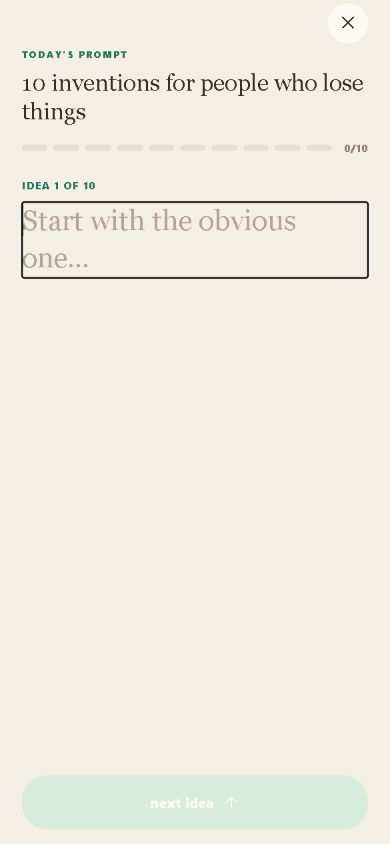
From the app's Dailies. The first few answers are the obvious ones. The last few are usually the good ones.
Ten song titles about a Tuesday.
0/10founding prices
Creaocity is coming to iPhone. Leave your email and we'll tell you the day it's out.
No. The exercises train general creative thinking, not notation or theory. They work the same whether you read music or play entirely by ear.
All three. The practice is medium-agnostic: a producer can rethink texture and arrangement, a songwriter can find a less obvious image or structure, and an instrumentalist can break habitual melodic and rhythmic choices.
No. It gives your own imagination something to push against, then leaves the musical decisions to you. Your melody, lyric, arrangement, and recording remain your work.
It can help you generate contrasting sections, question an arrangement, and choose a next move when a loop has nowhere to go. You can also keep the track as a pursuit and make the time you spend finishing it visible.
Use it before opening the DAW or picking up an instrument, while your options are still open. It also works as a reset when tweaking sounds has replaced making musical decisions.
Ideas for meals, play, stories and weekends.
forGet started on the blank page and unstick the middle.
forMore ideas, further from the obvious.
forFresh angles for essays and better questions.
forFresh thinking for strategy and positioning.
forIdeas for your next piece and a reason to keep making.